Why Is Jerusalem’s Status So Contested?
Can you imagine world governments debating the legitimacy of Rome as Italy’s capital, or Beijing, Moscow, or London as the capitals of their respective countries? Is there any other national capital whose status is so openly contested?
Jerusalem is an extraordinary exception. Israel’s capital is at the center of an enduring international dispute, one with roots that stretch far beyond modern politics.
Why is Jerusalem so contested? And why does this ancient city hold such a central place in the Bible, biblical prophecy, and God’s purposes for the nations?
From its ancient roots in Scripture to its modern status as Israel’s capital and its prophetic future, Jerusalem occupies a unique place in the biblical story. To understand the conflict surrounding the city, we must consider both its history and its spiritual significance.
Jerusalem’s Modern Status as Israel’s Capital
Jewish leaders accepted the 1947 United Nations (UN) partition plan for what was then British Mandate Palestine, despite significant reservations about the proposed borders. Chaim Weizmann, Israel’s first president, famously remarked that he was willing to take a state “even if it’s the size of a tablecloth.” The Jewish people just needed a homeland.
The city of Jerusalem, however, was excluded from the 1947 territory granted for Jewish sovereignty. Rather, the UN placed its status as a corpus separatum (Latin: separate entity) and an international body was to govern it.
The partition plan called for a referendum on Jerusalem’s status after ten years. Jewish leaders expected the city would be incorporated into Israel later. Perhaps—they hoped—the early internationalization would protect the city from the impending Arab war. It was wishful thinking.
The Arab states bitterly rejected both the partition plan and the internationalization of Jerusalem. Saturated in overconfidence, a coalition of Arab nations launched their intended war of annihilation of the Jewish homeland on May 15, 1948, when Israel’s modern state was one day old.
Jordan captured the Old City of Jerusalem two weeks later, on May 28, 1948. There was no corpus separatum protection or oversight. In fact, for the next nineteen years, until 1967, Jordan occupied east Jerusalem, dividing the city for the first time in history.
How Jerusalem Became Israel’s Capital
After months of fighting the War of Independence, the Israelis seized a miraculous victory in July 1949. With Arab rejection of the partition plan, Israel’s Prime Minister, David Ben Gurion, declared Jerusalem was no longer an international city, and established west Jerusalem as Israel’s seat of government.
Israel’s decisive victory in the 1967 Six-Day War secured Jerusalem’s reunification, drove the Jordanian army out of the city, and placed Israel’s united “eternal capital” under Jewish sovereignty for the first time in many centuries. The young nation wept and celebrated as soldiers reclaimed the Old City and the Temple Mount. It was a modern-day miracle.
In July 1980, Israel adopted into its Basic Law (like a constitution) a provision declaring Jerusalem the capital of Israel. Not all capitals of the world have their status anchored in law, but not every capital is like Jerusalem.
Since the 1967 reunification of Jerusalem and Israel’s 1980 Basic Law declaration, the UN’s hair has been on fire. No other nation has endured more disproportional censoring and hypocritical condemnation from the UN than Israel. Even as recently as March 2025, the UN General Assembly demanded yet again that Israel return behind 1967 borders while they actively address the situation in Jerusalem.
Jerusalem’s modern status is deeply contested, but its significance reaches far beyond modern politics. To understand why Jerusalem occupies such a central place in the biblical story, we must look at its roots in Scripture and its prophetic future.
Jerusalem’s Biblical Roots and Prophetic Future
The name Jerusalem is traditionally associated with peace, and the Bible first mentions Salem in Genesis 14, where it is ruled by Melchizedek, a unique figure whose name means “king of righteousness.” Salem is what we understand to be Jerusalem.
Scripture’s first mention of significant places, people, and themes are important because in them God reveals in seed form His heart and purpose for that subject. Their fullness will unfold and expand throughout scripture. God’s plan for Jerusalem is for her to be the foundation of peace and ruled by a righteous king.
Other names for Jerusalem include Zion, city of David, Ariel, the beloved city, a Bride, and God’s holy mountain.
For the Lord has chosen Zion; He has desired it for His habitation. “This is My resting place forever; Here I will dwell, for I have desired it.” (Ps. 132:13-14)
God said His name, His throne, His heart and eyes are in or toward Jerusalem, forever. (2 Kings 21:4; Jer. 3:17; 2 Chron. 7:16)
Why Is This City at The Center of God’s Heart?
Throughout Scripture, Jerusalem and Mount Moriah are associated with pivotal moments in God’s redemptive purposes. These include . . .
- Abraham was willing to offer Isaac, his only son, whom he loved. (Gen. 22:2-3)
- God provided for Abraham a substitute ram and spared Isaac, and the Lord was called The Lord Will Provide. (Gen. 22:13-14)
- King David purchased the threshing floor of Ornan and built an altar to the Lord to stop the destruction caused by sin. (1 Chron. 21:15-27)
- King David ruled as king over all Israel. (2 Sam. 5:5)
- King Solomon built the Temple, the House of the Lord. (2 Chron. 3:1)
- God designated the place for offering sacrifices. (Deut. 12:11; 2 Chron. 7:12)
- Jesus was crucified, on Passover, for the sins of the world and rose again to life on account of His sinless life, providing forgiveness for our sin and peace with God.
- The Holy Spirit was poured out on the Day of Pentecost and the Church was born. (Acts 2)
- Jesus, the greater Son of David, will one day rule and reign as the righteous King of kings. (Ps. 2:6; Isa. 24:23)
Jerusalem, the mountain of the Lord, is the place where the foundation of our peace with God was purchased by the blood of Jesus. He will return one day to establish His throne of peace in Jerusalem. (Jer. 3:16-17)
Jerusalem in Bible Prophecy: Satan’s Rebellion and Resistance
Let’s consider Satan’s efforts to thwart God’s purposes through two key words: Satan wants place and worship. Satan is the author of rebellion and confusion. Isaiah 14 addresses the king of Babylon in language that many understand as revealing Satan’s pride and rebellion.
Lucifer was created as an angel to exalt and serve God, but pride engulfed him. He determined in his heart to have God’s place, His throne of authority, and the worship that belongs to God alone. Isaiah revealed Satan’s heart in this way.
You said in your heart, I will ascend to heaven; I will raise my throne above the stars of God, and I will sit on the mount of assembly in the recesses of the north. I will ascend above the heights of the clouds; I will make myself like the Most High. (Isa. 14:13-14)
Ezekiel 28 tells us that because of Satan’s sin, God cast him from the mountain of God. Satan’s modus operandi is confusion and deception; he aims his sights on every place and form of worship belonging to the Lord. What he sought to do in the past, he’s still doing today. Solomon wrote there’s nothing new under the sun, and that’s true here as well.
The Schemes of the Enemy
Satan tempted Jesus during His forty days in the wilderness. According to Matthew, Satan took Jesus to a high mountain and showed Him the world kingdoms and their glory. Satan offered Jesus the world—place—if Jesus would bow and worship him. (Matt. 4:8-9)
In Joshua’s day when Israel was conquering their God-given inheritance in Canaan, Jerusalem was inhabited by Israel’s enemy and Judah believed the lie that they couldn’t drive them out. Jerusalem became a stronghold, a place, for the enemy.
His efforts with us are identical. Satan wants to supplant us from every place of freedom, victory, and jurisdiction that God has given us. Paul instructed believers, “Do not give the devil an opportunity.” The word opportunity in the Greek means, a place. (Eph. 4:27)
Considering Jerusalem’s calling as the mountain of God, where our freedom from sin was purchased, where Jesus’s throne will be set up, and pure worship will arise again even into the days of the New Jerusalem and forever (Rev. 21), is it any wonder there have been constant attacks against it?
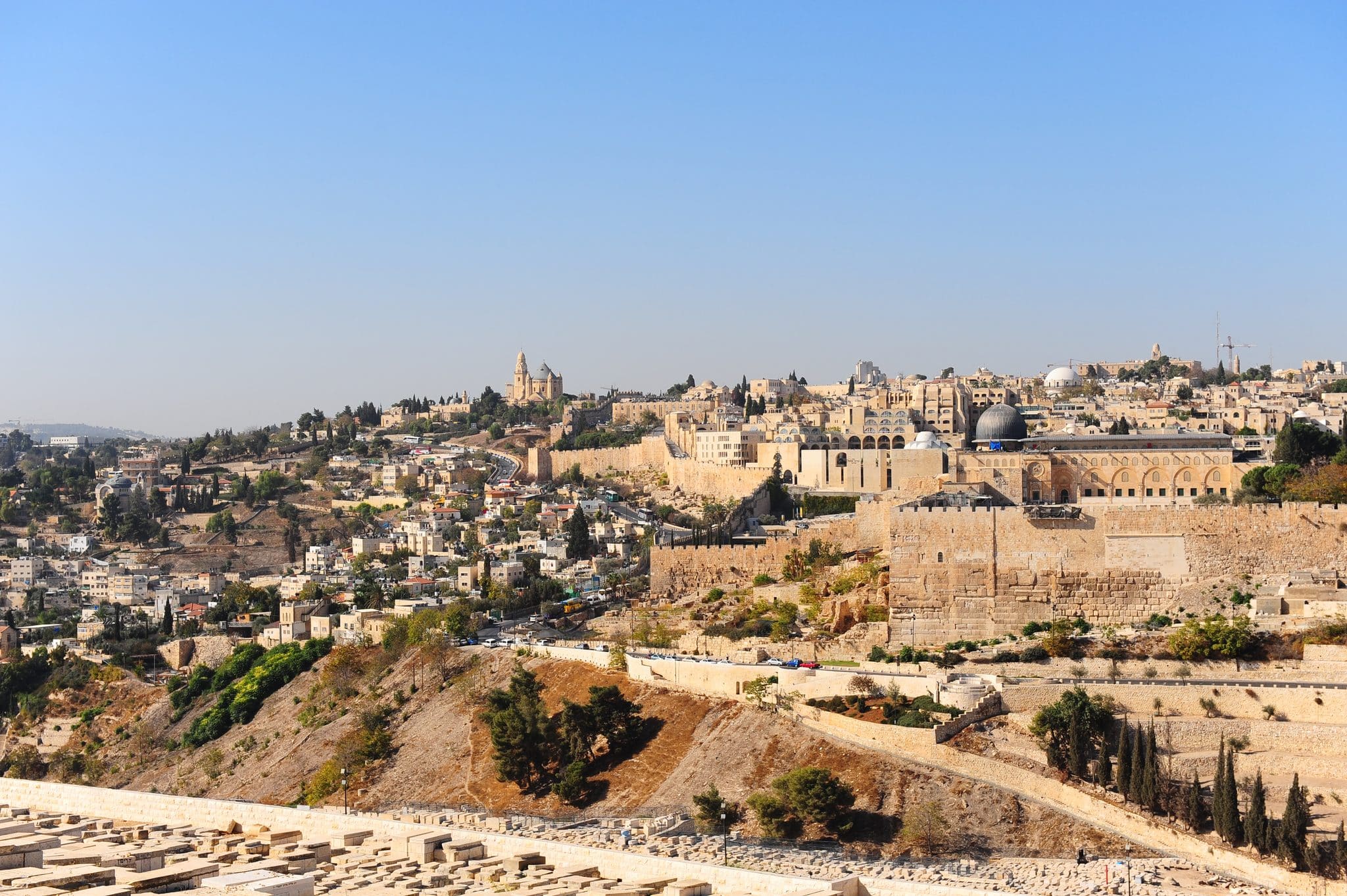
Today, on the Temple Mount where both Jewish temples once stood, the place of Jesus’s future throne, sit the Al-Aqsa mosque and the Dome of the Rock, where daily prayers are offered to Islam’s god, Allah. Satan is making a declaration if anyone is listening.
The War Over a Place
In the days prior to Jesus’s return as King, the Bible tells us a world leader—the antichrist—will arise, a man of lawlessness under Satan’s control. He will take his seat, a place, in a rebuilt temple in Jerusalem and demand the world’s worship. The antichrist will be arrogant and boisterous and will profane the holy place, but at His return, with the breath of His mouth, Jesus will bring this evil one to his complete end. (2 Thess. 2:3-4, 8)
Jerusalem’s struggle is a spiritual battle long before it’s a natural one. Satan has brought his war against God to this side of reality—into the seen realm, onto the world stage, and right into our lives as well.
But the Lord will have His way.
The Lord of hosts has sworn saying, “Surely just as I have intended so it has happened, and just as I have planned so it will stand.” (Isa. 14:24)
As believers, we’re called to offensive and defensive postures against the enemy. We are to use our most powerful weapons of warfare: the truth of God’s Word and praying in the Spirit. In the day of battle, we are to stand! (Eph. 6:10-18)
Pray for the Peace of Jerusalem
Jerusalem is the one location for which God calls us to pray. He summoned watchmen to take their place on the walls of Jerusalem. Men and women of prayer and worship who hold to the truth of His word and will pave the way for His fulfilled purposes. (Ps. 122:6; Isa. 62)
Will you join Christians around the world who pray for Jerusalem’s peace and security and for the salvation of every person (Jew and gentile) who lives within her borders? Will you station yourself on her walls, loving what God loves, and calling her to life?
For Zion’s sake I will not keep silent, and for Jerusalem’s sake I will not keep quiet, until her righteousness goes forth like brightness, and her salvation like a torch that is burning.
You who remind the Lord, take no rest for yourselves and give Him no rest until He establishes and makes Jerusalem a praise in the earth. (Isa. 62:1, 6-7)
Thus the Lord was moved by prayer for the land. (2 Sam. 24:25)
God’s Perfect Plan – From Israel to You: Free PDF Download
The Bible is full of God’s promises that can encourage our faith. Together, these promises make up one master plan of God.
You’re about to discover God’s perfect plan through the lens of 25+ references throughout Scripture.