More Than an Alliance
As the United States celebrates 250 years of independence, it is also a moment to reflect on the enduring relationships that have helped shape the nation’s moral and democratic identity. Among them, the bond between America and Israel (or Jewish people) stands out as one of the most remarkable friendships in modern history.
Rooted in shared ideals of faith and liberty, the alliance has survived wars, political disagreements, and shifting global realities. From George Washington’s promise that America would give “to bigotry no sanction” to modern declarations that the alliance remains “unbreakable,” this is a story of two nations connected by history and conviction.
To be sure, the modern State of Israel was established in 1948. But for centuries before that, the Jewish people preserved a distinct identity, and attachment to the land of Israel. From Abraham to Moses to King David, the story of Israel has lived in the hearts of millions. For some, it remained a distant hope or a fading memory. For others, it was a real and attainable goal.
And for many Jewish immigrants who came to American shores in search of safety and freedom, that hope remained alive. In that sense, the connection between America and the Jewish people did not begin with a modern alliance. It was already taking shape through Scripture and the promise of liberty long before the State of Israel was reborn in the twentieth century.
With Liberty and Justice for All
Some alliances are transactional, built on immediate interests and strategic convenience. Others are deeper, shaped by a common understanding of the world. The partnership between the United States and Israel belongs in the latter category.
Whatever one’s political view of the alliance, its durability is difficult to ignore. The United States and Israel have continued to stand together through regional upheavals and changing administrations. As Harvard University Press has observed, the US-Israel partnership has long stood apart from conventional pacts:
“Both proponents and critics have long understood the partnership between the United States and Israel as an exception to the norms of international alliances. The United States has given more monetary aid to Israel than to any other nation and has committed itself to maintaining Israel’s military edge in the region… Diplomatically as well, the relationship is in a category of its own: the United States has protected Israel from international criticism, most notably by casting many vetoes on its behalf in the Security Council of the United Nations.”
In other words, the US-Israel alignment has never fit neatly into the ordinary categories of international politics.
The Biblical Roots of America and Israel
The American and Jewish peoples shared a connection even before the official declaration of American independence in 1776. That connection rested on biblical, ethical, and cultural foundations. We know this from speeches, letters, political writings, and educational materials from the colonial and founding eras.
The Hebrew Bible profoundly influenced the language, imagination, and moral worldview of many early Americans. For example, the biblical teaching that human beings are created in the image of God (Genesis 1:27) helped shape Western ideas about the value of the individual.
The Hebrew Bible also shaped early American ideas about authority and human responsibility. In Scripture, rulers are not absolute; they are accountable. That biblical vision helped reinforce a principle central to the American experiment: government itself must be limited and subject to justice.
These Judeo-Christian foundations created a cultural affinity that would later shape America’s sympathy for the Jewish people and, eventually, its friendship with the modern State of Israel.
America’s first president gave that principle one of its clearest early expressions. In his 1790 letter to the Hebrew Congregation in Newport, Rhode Island, George Washington declared that the new nation would “give to bigotry no sanction, to persecution no assistance.” He also invoked the biblical language of Micah, expressing his hope that the “children of the stock of Abraham” in America would dwell in safety, with each one sitting “under his own vine and fig tree, and there shall be none to make him afraid.”
It was a remarkable statement of religious liberty and Jewish belonging at the dawn of the American republic.

Transform lives in Israel through Gospel-centered ministries.
FIRM is your trusted partner for Gospel impact in Israel.
Freedom, Democracy, and Human Dignity
The mutual democratic ideals helped shape both the emergence of modern Israel and its eventual partnership with the United States. Israel has grown into America’s closest ally in the Middle East.
Yet the relationship was not as immediate or as deeply rooted in its early stages as it would later become. President Truman made sure that he was the first to recognize Israel in 1948, but the US did not get behind Israel fully until the Six-Day War (5-10 June 1967). As historian Steven Spiegel noted, many American leaders initially viewed Israel less as a strategic asset than as a difficult burden of circumstance.
In those early decades, Israel faced wars, terrorism, economic challenges, and regional isolation. Yet even under those pressures, the young state built democratic institutions, held regular elections, maintained an independent judiciary, and fostered a vibrant civil society.
Over the course of the Cold War, Israel increasingly demonstrated its importance to the United States. Military effectiveness and intelligence capabilities made Israel a more consequential partner in American eyes.
At the same time, the US-Israel connection unfolded alongside one of the modern world’s most enduring conflicts. American leaders from both parties have repeatedly sought a future in which Israelis and Palestinians alike can live in peace and security.
But as the Cold War gave way to new geopolitical realities, cooperation between the United States and Israel broadened well beyond diplomacy alone.
Standing Together Through War and Terror
In the post–Cold War era, the United States increasingly saw itself not only as Israel’s ally, but also as a broker for peace in the region. The Oslo era represents both hope for peace and the painful reality of unresolved conflict.
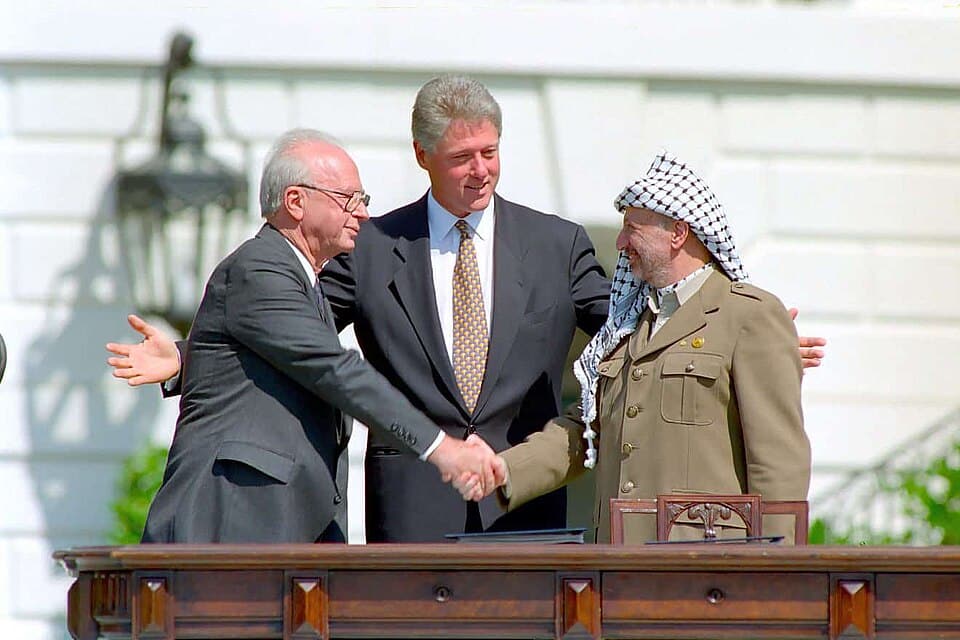
On the South Lawn of the White House, President Bill Clinton stood between Israeli Prime Minister Yitzhak Rabin and Palestinian leader Yasser Arafat as the two men shook hands after the Oslo Accords. The image became one of the defining diplomatic moments of that time.
American administrations invested enormous effort in advancing peace negotiations, but the promise of peace did not translate into lasting security. The assassination of Israeli Prime Minister Yitzhak Rabin and, later, the collapse of peace talks at Camp David in 2000 exposed how fragile the process truly was.
Then came September 11, 2001—a moment that fundamentally altered how many Americans viewed Israel’s security challenges.
The Aftermath of 9/11 for American-Israeli Relations
As the United States confronted the realities of global terrorism, many Americans came to better understand the challenges Israel had long faced. Counterterrorism cooperation, intelligence sharing, and the defense of democratic societies became even more central pillars of the alliance.
The years that followed exposed the limits of the peace process. Hamas’s rise in Gaza, the growing divide between Hamas and the Palestinian Authority, and repeated cycles of violence reinforced Israeli security concerns and deepened American skepticism that a lasting settlement could be achieved quickly.
Two parallel realities came into view. On the one hand, the US-Israel alliance strengthened through defense cooperation, technological innovation, and expanding economic ties. On the other, hopes for a comprehensive peace agreement between Israelis and Palestinians gradually receded.
Even as new diplomatic possibilities emerged (most notably the Abraham Accords – more on that later), the Israeli-Palestinian struggle remained unresolved. The attacks of October 7, 2023, served as a devastating reminder that the underlying conflict had not disappeared.
When the “Bond” Was Tested
Through the decades, the United States has remained Israel’s closest ally, even through periods of tension and recalibration. Changes in leadership in both countries have often brought policy disagreements to the surface, particularly over security and regional strategy.
During the presidency of Barack Obama and the leadership of Israeli Prime Minister Benjamin Netanyahu, several areas of disagreement became especially visible. They clashed over Iran’s nuclear program, the Israeli-Palestinian peace process, and Israeli settlement expansion in the West Bank.
Even so, President Barack Obama made the now-famous declaration: “The bond between the United States and Israel is unbreakable.” (2010)
The Obama-Netanyahu years showed that serious policy disputes could strain the alliance without severing it.
Why Israel Matters to Millions of American Christians
But while presidents and prime ministers have come and gone, the affinity many American Christians feel toward Israel and the Jewish people has endured for decades. That is because, for millions of Americans, their connection to Israel begins not in the halls of government, but in the pages of the Bible.
This spiritual heritage predates the modern states of both nations. And where the Bible is treasured, Israel is seldom viewed as just another piece of foreign policy.
From Abraham’s journey to the Promised Land, to the Exodus, the kingdoms of Israel and Judah, and the life and ministry of Jesus, the land of Israel inhabits a central place in the Christian faith. For centuries, these biblical narratives formed part of a shared cultural vocabulary in the West, even among those who were not particularly religious.
Faith Speaks to Freedom and Dignity
An important example is the language of liberation that shaped the American civil rights movement. It drew from the Hebrew Scriptures and was frequently echoed by Reverend Martin Luther King Jr. in his speeches and writings. His calls for justice often invoked biblical phrases such as “let justice roll down like waters” and “let my people go.”
It is worth noting here that Rev. King also affirmed Israel’s right to exist. Members of the Jewish community marched alongside African Americans in the struggle for equality, just as Black voices were raised to affirm the right of Israel to exist within its historic home. The relationship was marked by a real sense of solidarity.
Despite all this, sadly, biblical literacy has declined in the Western world. Ideas such as covenant, justice, human dignity, and liberty—concepts that shaped both Jewish and American history—are increasingly discussed apart from their biblical roots.
This shift represents a significant change in the intellectual environment in which discussions about Israel now take place. Fewer people grow up with a familiarity of Scripture, and they may be less likely to view Israel through the biblical lens that shaped earlier generations of Americans and Christians.
Across the nation, a growing number of believers are beginning to wonder if they possess the resolve necessary to safeguard the Judeo-Christian foundations within the broader cultural landscape of the United States.
From Start-Up Nation to Strategic Ally
Yet even as cultural attitudes evolve, the modern connection between the United States and Israel continues to develop.
Often referred to as the “Start-Up Nation,” Israel has become a world leader in fields ranging from cybersecurity and artificial intelligence to water management and medical research. These achievements have firmly established Israel as an essential strategic partner for the United States.
For example, many American companies maintain research and development centers in Israel, while Israeli startups frequently seek American investment and market access. These ties have proven to serve the interests of both nations.
A Changing Middle East
As already mentioned, Israel has often been described as one of America’s closest allies in the pursuit of a more stable Middle East. That partnership relies heavily on the fact that both nations are democracies shaped by elections, independent courts, and a free press.
Yet Israel’s growing strategic importance was not limited to its connection to Washington. In time, several Arab states, especially the UAE and Bahrain, also came to see potential benefits of open cooperation with Israel. Not to mention, all also recognize Iran as a common threat.
Quiet ties had already been developing behind the scenes, and the Trump administration helped turn them into formal normalization. The result was the Abraham Accords of 2020, a historic agreement that marked a significant shift in the diplomatic landscape of the Middle East.
The Abraham Accords demonstrated that the story of Israel and its neighbors is not frozen in the past. And, they also underscored the continuing role of the United States as a force for change in the region.
Nevertheless, the optimism generated by the Abraham Accords was profoundly challenged by the Hamas attack on Israel on October 7, 2023, the deadliest assault in the country’s history. The war that followed spread to include Iranian-backed groups across the region. The United States provided unprecedented military and intelligence support to Israel.
The resulting war with Iran produced the closest operational military cooperation between the United States and Israel in the history of their alliance.

America at 250: Looking Forward Together
There is one more thing to be said about the unique connection between Israel and the United States. At the 250th anniversary of the American declaration of independence, let us not forget that the US affinity with Israel has often mirrored the nation’s broader spiritual condition.
For generations, Americans understood the story of Israel as part of what shaped their faith and their understanding of God’s purposes in the world. We must remember the powerful truth that the God of Abraham, Isaac, and Jacob is not absent from history, but sovereign over it.
When a people remember the Bible, they remember why Israel matters. They remember that history is not random, that God’s covenant purposes still matter, and that freedom itself is a gift that must be defended. If the bond between America and Israel has endured for so long, it is because it has been sustained by conviction as well as hope. With America turning 250, that is a legacy worth preserving.